
Overview
MongoDB is a document-oriented NoSQL database, ideal for:- User profiles and account data
- Content management systems
- Event logs and analytics
- Flexible schema applications
Why Connect MongoDB?
Traditional AI agents struggle with operational data because:- Data changes constantly - Static exports become outdated quickly
- Manual exports go stale - Syncing requires constant maintenance
- Querying requires technical knowledge - Non-technical users can’t access data easily
- Sync fresh data whenever context is needed
- Search semantically across collections and documents
- Combine database results with other data sources
- Query in natural language without writing aggregation pipelines
Getting Started
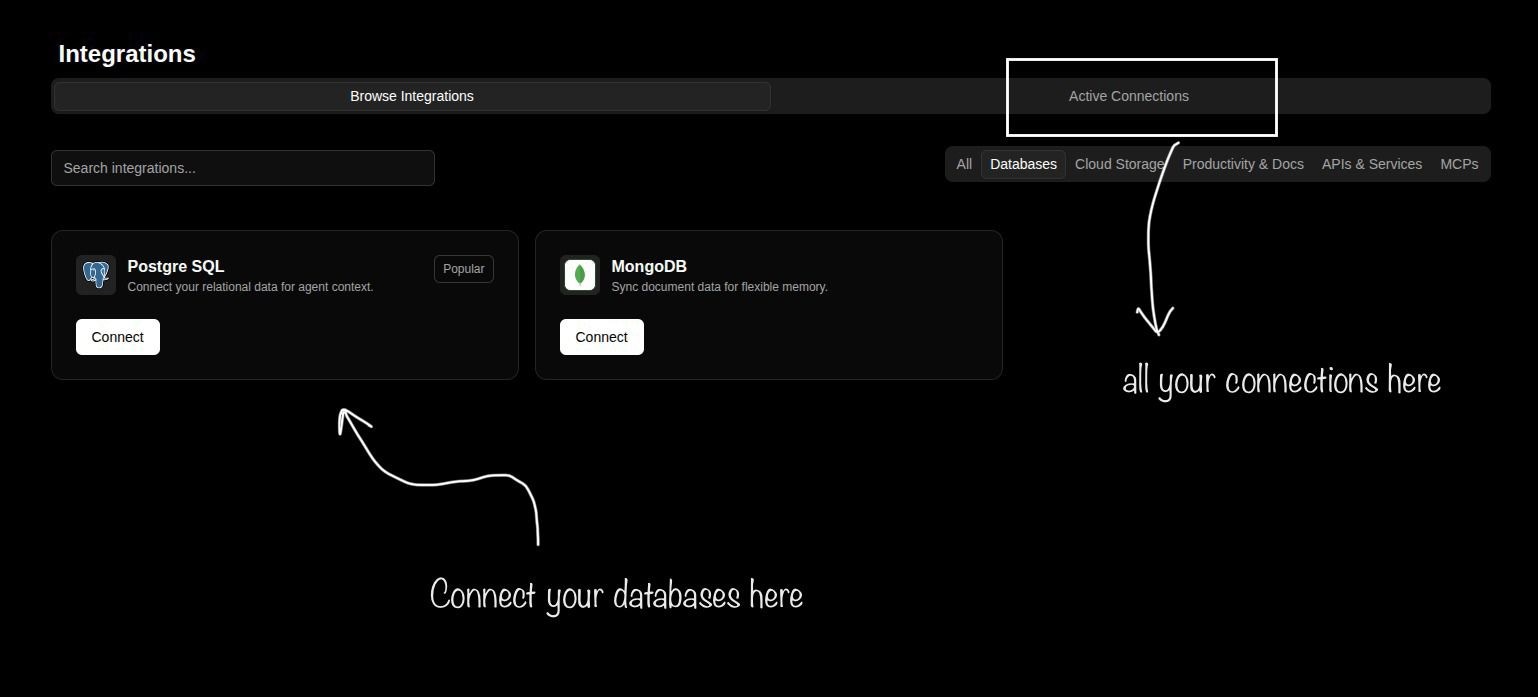
- Navigate to the Alchemyst Integrations page
- Click Add Integration → MongoDB
- Provide your connection credentials
- Configure which data to sync
- Start querying your data with natural language
Connection Requirements
Prerequisites
- MongoDB cluster (Atlas, self-hosted, or cloud provider)
- Database user with read permissions
- Network access to your MongoDB cluster
Required Information
- Connection URL - MongoDB connection string in format:
- Auth Source (optional, defaults to
admin) - Database Name - Specific database to index
- Cluster Name (optional, for Atlas clusters)
What Gets Indexed
Alchemyst can index and make searchable:- Collections - All documents within specified collections
- Documents - Individual records with all fields
- Aggregation Results - Pipeline outputs and computed data
- Embedded Documents - Nested data structures
- Array Fields - List data and sub-documents
How Data is Structured
When you sync MongoDB collections, Alchemyst preserves your document structure while optimizing for search:Example Query Patterns
How to Connect
- Go to Alchemyst Integrations
- Click Add Integration → MongoDB
- Enter your connection details:
- MongoDB connection URI
- Select collections to index
- Test the connection
- Configure sync settings
- Save and activate the integration
Connection String Examples
MongoDB Atlas
Self-Hosted MongoDB
MongoDB with Replica Set
Best Practices
- Use read-only roles - Create users with
readrole only - Enable authentication - Always use authenticated connections
- Use connection pooling - Improve performance for large collections
- Filter collections - Index only necessary data to reduce load
- Monitor queries - Track slow operations and optimize as needed
Security Best Practices
Access Control
- Use read-only credentials - Prevent accidental data modification
- Create dedicated service accounts - Separate Alchemyst access from application users
- Apply principle of least privilege - Grant access only to required collections
Network Security
- Enable SSL/TLS encryption - Protect data in transit
- Whitelist Alchemyst IPs - Restrict database access by IP address
- Use private networks - Connect via VPN or private peering when possible
- Enable firewall rules - Block unauthorized access attempts
Ready to connect MongoDB? Visit the Alchemyst Integrations page to get started.