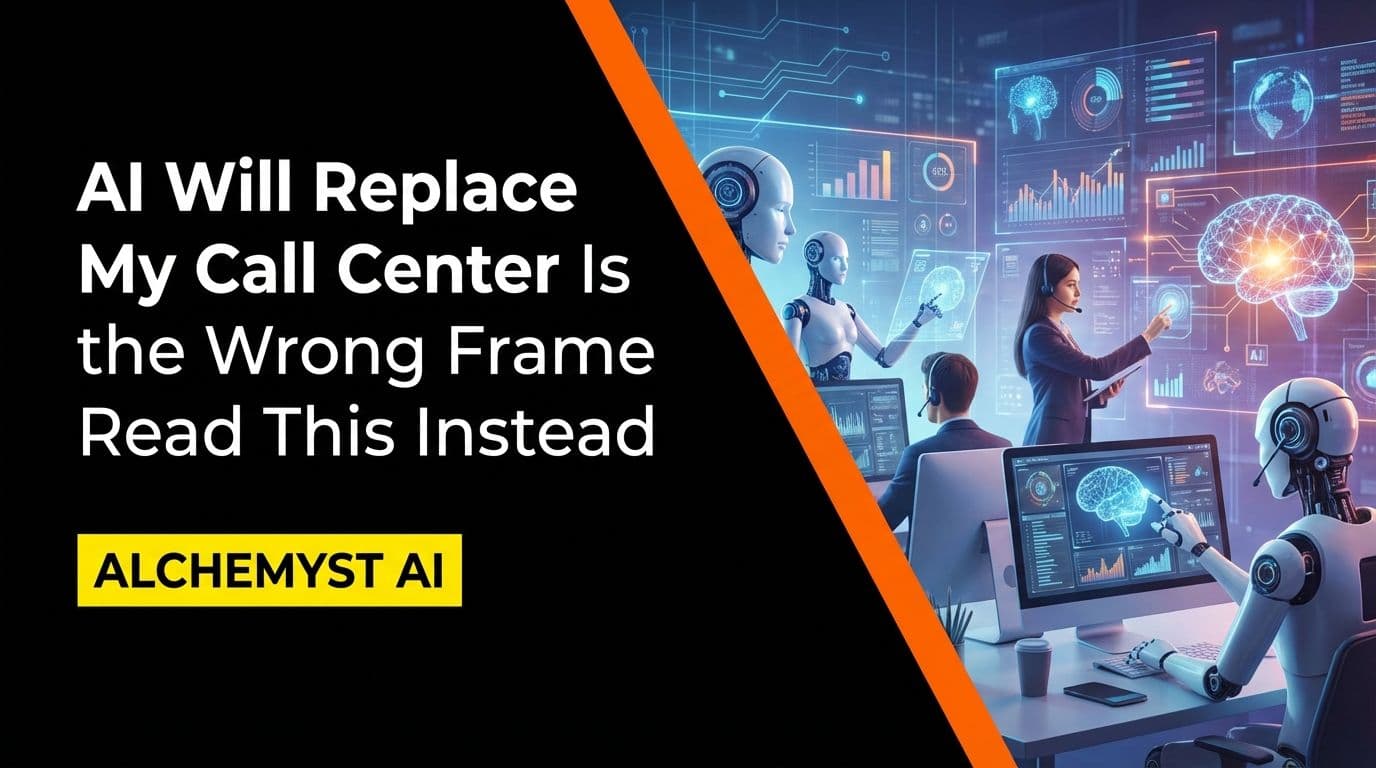

The fear is straightforward: AI voice agents will eliminate call center jobs. The reality is more nuanced — and more useful. Alchemyst's Kathan voice OS eliminates the worst parts of call center work (repetitive dials, re-identification, DND filtering, post-call logging) and frees human agents for conversations that need judgment, empathy, and negotiation. The question isn't "AI or humans." It's "which tasks should each handle?"
The Data Behind the Reframe
In the JK Shah Classes deployment, the Kathan OS handled over 500,000+ calls deployed daily. Of those, a significant portion became meaningful conversations (over 1 minute). The human team's role shifted from dialing to reviewing qualified leads, handling complex objections, and closing enrollments. Kathan didn't replace the team — it changed what the team spent their time on. This is a prime example of being built in India, for the world.
| Task | Before Kathan | After Kathan |
|---|---|---|
| Cold dialing | Human agents: 100-120 calls/day | Kathan handles all 500,000+ daily dials |
| DND filtering | Manual check before each call | Automated at platform level |
| Language matching | Assign agents by language skill | Kathan auto-selects from 12+ Indian languages (Hindi, Tamil, Telugu, Gujarati, Kannada, Marathi, Bengali, Malayalam, Punjabi, Odia, Assamese, Urdu) and international languages (English, Arabic, Spanish, French, Mandarin, Japanese) per lead |
| Lead qualification | Human judges during call | The Kathan voice OS qualifies, surfaces top leads |
| Complex objection handling | Human (when they reach the lead) | Human (with full context brief from the voice agent) |
| Enrollment closing | Human | Human (with pre-qualified, warm leads) |
The human agents didn't become redundant. They became more effective. Instead of spending 80% of their day on dials that don't connect, they spent their time on conversations that matter — with leads the Kathan engine had already qualified and contextualized.
Three Deployment Models
Model 1: Full Automation
The Kathan voice agent handles everything end to end. No human in the loop. This works for transactional campaigns: appointment confirmations, feedback collection, payment reminders, and delivery notifications. The conversations are short, predictable, and don't require judgment. Full automation is appropriate when the call's value is in completion, not persuasion.
Unacademy's NPS feedback campaign is a clean example of this model in action. The entire process, from dialing to data capture, was fully automated. The AI agent ran 14,258 calls to collect Net Promoter Score feedback from learners without a single human caller involved, demonstrating how to execute a high-volume, transactional campaign with perfect consistency and zero human overhead.
Model 2: AI-First, Human-Close
Kathan (कथन) qualifies leads and surfaces the best ones to human agents. The human's first conversation is with a warm, pre-qualified lead — not a cold dial. This is the model that delivers the highest ROI for sales and enrollment campaigns, where the final conversion requires human judgment, empathy, and negotiation skill. The JK Shah Classes deployment, which used the platform to handle initial outreach and qualification before handing off warm leads to their enrollment counselors, is a classic example of this model.
In this model, context is what makes the handoff work. When the AI passes a lead to a human agent, it doesn't just pass a name and phone number. It passes a context package: what the lead is interested in, what language they prefer, what objections they raised, what their timeline looks like, and what the AI recommends as the next step. The human agent walks into the conversation fully briefed.
Model 3: AI-Assist
Human agents make the calls, but Kathan's voice OS provides real-time context: who the person is, their history, the recommended approach. The agent is more effective because the context layer does the prep work that would otherwise take 2–3 minutes of manual CRM lookup before each call.
This model works for high-value, relationship-driven interactions where the human touch is essential from the first second — enterprise sales, wealth management, healthcare consultations. The AI doesn't replace the human; it makes the human faster and better informed.
3 Models
Full automation, AI-first/human-close, and AI-assist — context makes models 2 and 3 work
Why Context Makes the Difference
Models 2 and 3 only work if the AI can pass meaningful context to the human agent. Without context, the handoff is just a name and a phone number — the human agent still starts from zero. With context, the handoff includes everything the AI learned: language preference, interest level, objection history, decision timeline, and recommended approach.
This is where context engineering transforms the human-AI collaboration. The context layer doesn't just serve the AI agent — it serves the human agent too. Every interaction, whether AI-led or human-led, contributes to and draws from the same persistent context graph. The lead's experience is seamless regardless of who they're talking to.
"The question isn't 'AI or humans.' It's 'which tasks should each handle?' Kathan excels at scale, consistency, and context retrieval. Humans excel at judgment, empathy, and negotiation. The best deployments use both — connected by a shared context layer."
The Human Agent's Day: Before and After Kathan
| Before Contextual AI | After Contextual AI with Kathan | |
|---|---|---|
| Morning | 100 cold dials, 15 connections | Review 15 pre-qualified leads with full context briefs from Kathan |
| Midday | Manual CRM lookup between calls | AI-generated summaries ready before each conversation |
| Afternoon | 2 qualified conversations (if lucky) | 12 productive conversations with warm leads |
| End of day | Exhausted, low conversion | Higher close rate, focused on high-value work |
| Job satisfaction | Repetitive, high rejection | Meaningful conversations, visible impact |
The shift isn't about replacing humans. It's about removing the parts of the job that humans shouldn't be doing — repetitive dials, DND filtering, re-identification, post-call logging — and redirecting human talent toward the conversations that actually require human skill.
See how Alchemyst's enterprise voice OS works alongside your team — not instead of them.