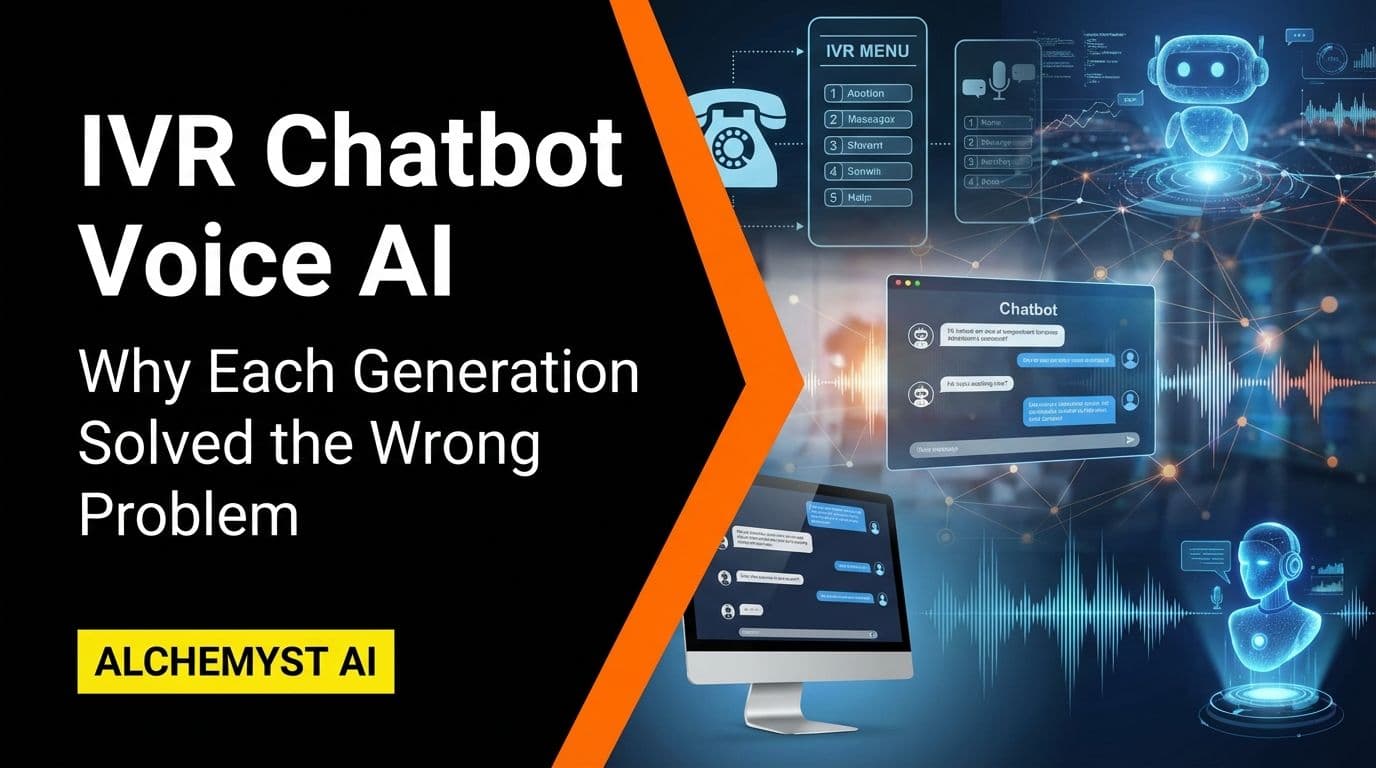

Every generation of customer communication technology solved a real problem. And every generation carried forward a structural flaw that the next generation inherited. Understanding this lineage explains why most voice AI deployments disappoint — and what it takes to break the pattern.
Generation 1: IVR Solved Routing
"Press 1 for sales, press 2 for support." Interactive Voice Response systems reduced the need for human switchboard operators. They could handle thousands of concurrent callers and route them to the right department without human intervention. For the first time, a business could scale its phone operations beyond the number of people answering calls.
What IVR solved: Routing at scale. A caller could reach the right department without waiting for a human to transfer them.
What IVR missed: Understanding. IVR never understood anything. You navigated a menu tree, and the tree was the same for every caller. A first-time caller and a returning customer with an open support ticket got the same "Press 1" experience. No memory, no personalization, no intelligence.
Generation 2: Chatbots Solved Availability
Chatbots could answer questions at 2 AM. They understood text input (to varying degrees), could handle FAQ-style queries, and didn't require phone infrastructure. For businesses with high volumes of repetitive questions — order status, store hours, return policies — chatbots reduced the load on human support teams.
What chatbots solved: 24/7 availability for text-based interactions. Customers could get answers without waiting for business hours.
What chatbots missed: Memory. Chatbots had no persistent context. Every conversation started from scratch. Close the browser window, reopen it, and the chatbot has no idea you were just talking. Worse, chatbots couldn't handle voice — they operated in a text-only channel that excluded the majority of customer interactions in markets like India, where phone calls remain the dominant communication channel.
Generation 3: Voice AI Solved Naturalness
Voice AI agents can converse in real speech, understand intent, handle open-ended questions, and respond with natural-sounding voices. They operate on the phone — the channel that matters most for sales, collections, and high-value customer interactions. The technology is genuinely impressive in isolation.
What voice AI solved: Natural, spoken-language interaction at scale. The agent can handle complex conversations, not just menu navigation or FAQ matching.
What voice AI missed: Continuity. Most voice AI systems carried forward the same structural flaw as chatbots: no persistent context. Each call is an island. The agent is natural-sounding but amnesiac. It can have a great conversation — once. On the second call, it starts over.
The Problem None of Them Solved
| Generation | Solved | Missed | Memory Model |
|---|---|---|---|
| IVR | Routing at scale | Understanding | None — same menu for everyone |
| Chatbot | 24/7 availability | Voice channel + memory | Session only — erased on close |
| Voice AI (stateless) | Natural conversation | Continuity across interactions | Per-call — erased between calls |
| Alchemyst Kathan | All of the above + continuity | — | Persistent — grows over time |
The actual problem none of these generations solved is continuity. A customer interacts with your business 5–10 times across their lifecycle. Each interaction generates information that should inform the next one. IVR didn't store it. Chatbots didn't transfer it. Most voice AI generates it but doesn't carry it forward.
Generation 4: Alchemyst Kathan (कथन) Closes the Loop
Context engineering represents the fourth generation — not because the voice is better (though it is), but because the architecture is fundamentally different. Alchemyst's Kathan engine operates on a context layer that:
Persists across interactions. Every call generates context that's indexed, searchable, and automatically retrieved on subsequent calls. The lead's context graph grows over time, making every interaction more efficient.
Retrieves prior state at call time. Before the agent dials, the context engine assembles a focused brief: prior interactions, language preference, objection history, campaign context. The agent doesn't start from zero — it starts from where the last conversation left off.
Shapes the conversation dynamically. The agent's script, language, opening line, and objection handling all adapt based on what the context layer provides. Two leads in the same campaign can have completely different conversations because their context is different.
"IVR solved routing. Chatbots solved availability. Voice AI solved naturalness. None solved continuity. Context engineering is the architectural shift that finally closes the loop — making every interaction informed by every prior interaction."
The Customer Lifecycle, With and Without Context
Consider a customer's journey through five touchpoints with an EdTech company: initial inquiry, course demo, enrollment discussion, parent-teacher meeting, and feedback collection. Without context, each touchpoint is disconnected — the agent at each stage starts from zero, asks the same questions, and has no awareness of prior interactions.
With context, each touchpoint builds on the last. The enrollment call knows what the demo covered. The parent-teacher meeting knows what was discussed during enrollment. The feedback call knows the entire history. The customer feels recognized, not interrogated.
This is what the Kathan voice OS demonstrated at scale: 500,000+ calls deployed daily across campaigns, where retarget campaigns outperformed cold campaigns because the agent carried context forward. The technology finally matches the way customers actually interact with businesses — not as isolated events, but as an ongoing relationship. Built in India, for the world.
The Evolution of a Single Use Case: NPS Feedback
The evolution from stateless to contextual AI is best illustrated with a single, common use case: Net Promoter Score (NPS) feedback collection. The goal is simple — ask a customer to rate their experience on a scale of 1-10. But how the technology handles that simple request reveals its underlying architecture.
IVR: "You have received a service from us. Press 1 to rate your experience. Press 2 to opt-out." The interaction is a rigid, one-way menu tree.
Chatbot: Sends a link to a web form with a 1-10 rating scale. It's functional but impersonal and still requires the user to leave the chat to complete the action.
Stateless Voice AI: "Hello, we're calling to get your feedback. On a scale of 1 to 10, how likely are you to recommend us?" The customer says "6". The AI says, "Thank you for your feedback. Goodbye." The agent captures the number, but nothing else. It's a transactional, shallow interaction.
Alchemyst's Kathan Engine: "Hi [Learner Name], calling from Unacademy. I see you recently completed the 'Advanced Calculus' course. On a scale of 1-10, how likely are you to recommend it to a friend?" The learner says "6". Instead of ending the call, the agent probes: "Got it, a 6. Could you tell me a bit about what we could have done better with the course material or the instructor?" The agent listens, understands the nuanced feedback ("the final module felt rushed"), and captures it as structured data in any of our 12+ Indian languages (like Hindi, Tamil, Telugu, Gujarati, Kannada, Marathi, Bengali, Malayalam, Punjabi, Odia, Assamese, Urdu) or international languages (English, Arabic, Spanish, French, Mandarin, Japanese).
This is the difference. The first three generations capture a data point. Kathan captures insight. Unacademy used this to make 14,258 calls, not just to get a score, but to understand the why behind the score, at a cost of just ₹10.79 per detailed response. That's the evolutionary leap.
See how Alchemyst's enterprise voice OS represents the fourth generation — and why it matters for your business.