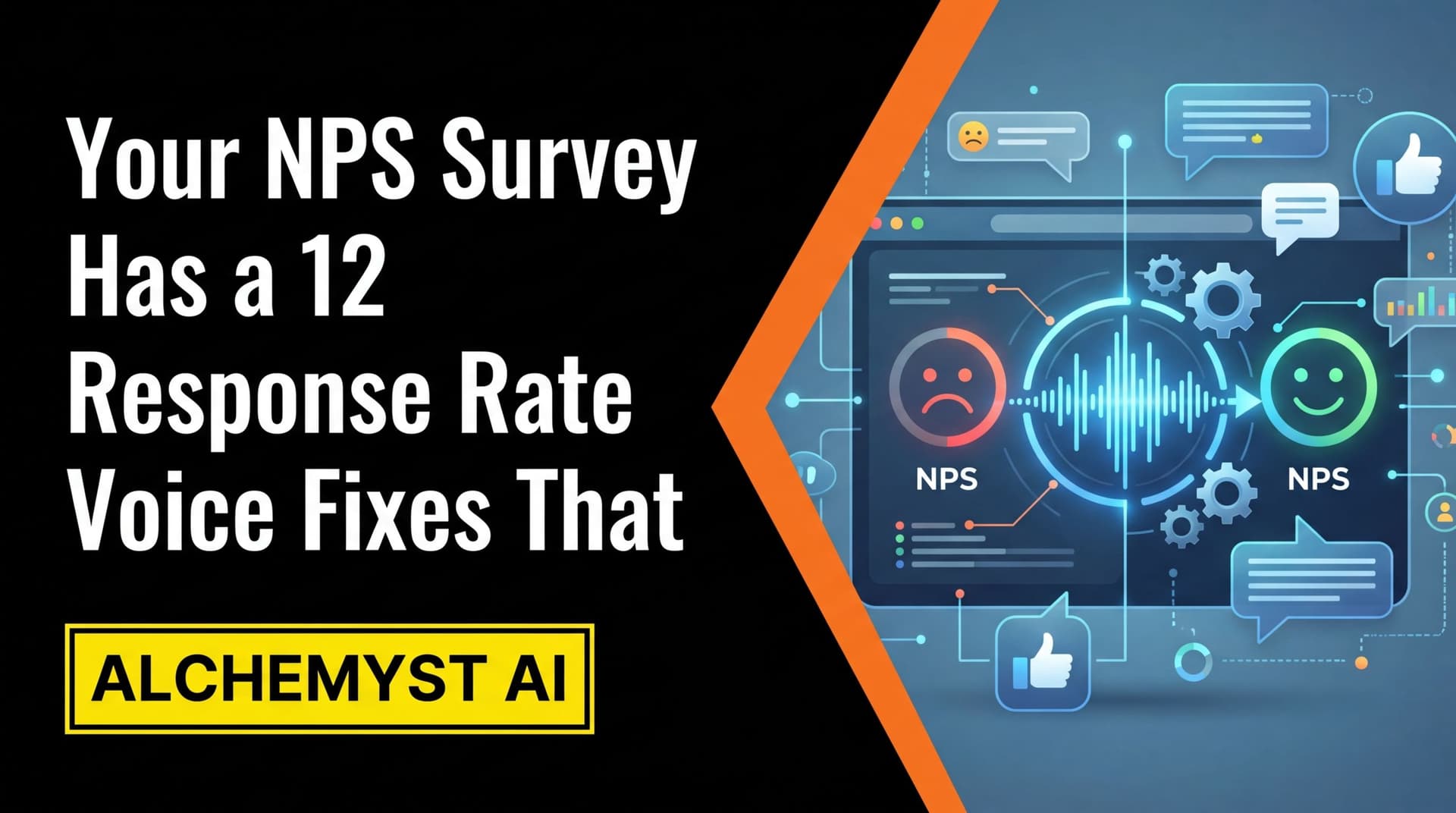

Your NPS program has a measurement problem disguised as a response problem. Email surveys return 12–15% response rates. SMS gets 20–25%. Both give you a number. Neither gives you the reason behind the number. Product teams end up with a score they can track on a dashboard but can't act on — because the qualitative signal that explains the score never arrives.
The Response Rate Gap Is a Channel Problem
When Unacademy deployed Alchemyst's Kathan enterprise voice OS to collect NPS from its learners, the results redefined what feedback collection at scale looks like. With over 500,000+ calls deployed daily across 12+ Indian languages (including Hindi, Tamil, Telugu, Gujarati, Kannada, Marathi, Bengali, Malayalam, Punjabi, Odia, Assamese, and Urdu), the Kathan voice agent connected with 35.2% of learners and held meaningful conversations with 22.1% — capturing not just the NPS score, but the qualitative reasoning behind it. This is a testament to a platform built in India, for the world.
| Channel | Response Rate | Cost / Response | Qualitative Depth |
|---|---|---|---|
| Email NPS | 12–15% | ₹2–5 | Numeric only; comment box skipped by 80% |
| SMS NPS | 20–25% | ₹5–10 | Terse; character limits reduce depth |
| Voice AI NPS (Kathan) | 35.2% | ₹10.79 | Full conversational feedback with probing |
The cost per response is higher with voice — ₹10.79 vs. ₹2–5 for email. But the information yield per response is incomparably richer. An email response tells you "7." A voice response from Kathan (कथन) tells you "7 — content quality is strong, but video buffering in Module 4 caused frustration. Learner requested HD download option." That's the difference between a metric and an insight.
35.2%
Kathan NPS connection rate — Unacademy deployment
What Makes Voice-Based NPS Collection Different
1. Higher response rates because calls demand attention
An email sits in an inbox competing with 47 other unread messages. An SMS gets glanced at and swiped away. A phone call is harder to ignore. When the Unacademy voice agent, powered by the Kathan voice OS, called learners, it connected at 35.2% — nearly 3x the email benchmark. Campaign 1, targeting the freshest cohort, hit 45.5% connection rates. That's not a marginal improvement. It's a category shift.
| Campaign | Leads | Calls Made | Connection Rate | Success Rate |
|---|---|---|---|---|
| Campaign 1 | 2,574 | 4,446 | 45.5% | 26.1% |
| Campaign 2 | 4,099 | 4,099 | 37.1% | 23.7% |
| Campaign 3 | 4,448 | 7,488 | 30.4% | 18.1% |
| Campaign 4 | 3,967 | 3,967 | 23.7% | 18.5% |
2. Conversations capture qualitative reasoning
A learner doesn't just say "6." They say "6, because the video quality in my Advanced Tax module was poor." The Alchemyst Kathan engine, because it knows the learner's course enrollment and engagement history, can probe further: "Was that throughout the module or in specific lessons?" This follow-up question — impossible without context — transforms a data point into an actionable insight.
3. The context layer makes the conversation productive
Without context, a voice agent asks generic follow-ups: "Can you tell me more?" With Alchemyst's context engine, the agent references the learner's actual experience — their specific course, their engagement patterns, their support ticket history. The conversation feels like it's with someone who knows them, not a stranger reading a script. Average call duration across connected calls was 47.7 seconds — long enough for a real conversation, not just a number.
4. Cost is lower than staffed outbound
Unacademy's total spend was ₹11,963 for 1,109 meaningful conversations. That's ₹10.79 per NPS response. A 15-person BPO team calling 15,000 learners would cost ₹2–4 lakh and take weeks. The Kathan OS completed the same scope in days at a fraction of the cost — and the data was structured and queryable from the moment the call ended.
₹10.79
Cost per NPS response — Unacademy deployment
When to Use Which Channel
Voice AI NPS isn't a replacement for email surveys. It's a complement for the segments where email fails. Here's the framework:
| Scenario | Best Channel | Why |
|---|---|---|
| Annual survey, 100K+ users, trendline tracking | Low cost, high volume, numeric sufficient | |
| Post-purchase / post-class, mobile-first audience | SMS | Time-sensitive, quick response, low friction |
| High-value cohorts, product decisions need qualitative depth | Kathan Voice AI | 35.2% response, conversational probing, structured insights |
| At-risk segments with low email engagement | Kathan Voice AI | Phone cuts through inbox noise; captures churn signals |
| Enterprise accounts, relationship-driven feedback | Kathan Voice AI | Personalized conversation builds trust while collecting data |
Run email NPS across your full base for the trendline. Use the Kathan voice OS for the segments where the qualitative depth justifies the cost — paid subscribers, enterprise accounts, at-risk cohorts, learners in critical program stages. Use the voice data to enrich and explain the patterns in the email data.
"One case study proves a product works. Two prove a pattern. Alchemyst Kathan's Unacademy NPS deployment (35.2% connection) alongside JK Shah's enrollment campaigns (38.7% connection) shows the context layer delivers consistently across use cases."
The Information Density Gap
The real argument for voice-based NPS isn't the response rate. It's the information density per response. Consider what each channel returns for the same learner:
What You Get Back — Per Channel
- Email: Score: 7. (No comment.)
- SMS: Score: 7. 'It's good.'
- Kathan Voice AI: Score: 7. Content quality is strong. Video buffering in Module 4 caused frustration across 3 lessons. Learner requested HD download option. Likely to renew if issue is fixed within 2 weeks.
The email response is a data point. The SMS response is a data point with a label. The voice response is a structured insight that a product team can act on in their next sprint. At ₹10.79 per response, that insight is cheaper than a single hour of a product manager's time spent guessing what the "7" means.
If your NPS program is stuck at 12% response rates and your product team is making decisions on incomplete data, the fix isn't a better email subject line. It's a channel that demands attention, holds a conversation, and captures the reasoning behind the score. See how Alchemyst's enterprise voice OS works — with over 500,000+ calls deployed daily with measurable results from week one.