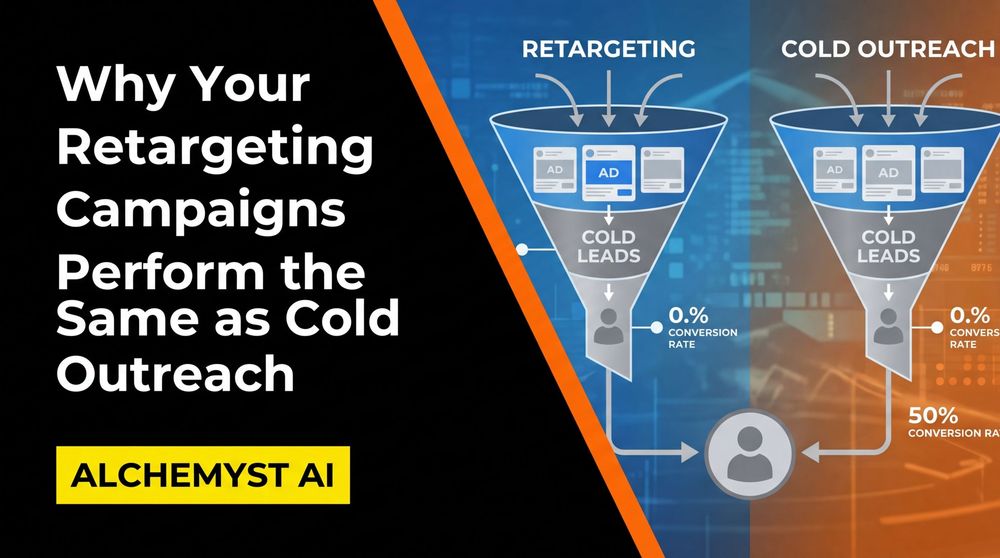
The whole point of retargeting is that you know something about the lead. If your voice agent doesn't use that knowledge, retargeting is just cold calling with a smaller list. And the data proves it: when context doesn't carry forward, retarget campaigns perform within 1–2 percentage points of cold outreach. You're paying retarget costs for cold-call results.
The Data Split: Cold vs. Retarget
In the JK Shah Classes deployment, Alchemyst ran both cold and retarget campaigns across the same lead pools. The performance gap was significant — but only because the retarget campaigns carried context from prior interactions, powered by the Kathan voice OS (कथन).
| Metric | Cold Campaigns | Retarget Campaigns | Lift |
|---|---|---|---|
| Connection rate | 37–38% | 42.7% | +12–15% |
| Success rate (career guidance) | 14.4% | 21.3% | +48% |
| Gujarat retarget connection | — | 57.3% | 4x industry avg |
| Gujarat retarget success | — | 29.5% | 2x cold baseline |
42.7%
Retarget connection rate — because the Kathan agent remembered the last conversation
The gap was even wider on success rate. Retargeted Gujarat leads hit 29.5% meaningful conversations compared to 14.4% on career guidance cold outreach. The retarget leads weren't inherently better — they were better served, because Alchemyst's Kathan engine knew what to say.
A similar pattern emerged in a recent NPS feedback campaign for Unacademy. A campaign targeting the freshest leads (Campaign 1) achieved a 45.5% connection rate. When the system retried non-responsive leads a few days later (Campaign 3), the connection rate dropped to 30.4% across 7,488 calls to 4,448 leads. While lower, this was still a significant improvement over a pure cold call, demonstrating that even a simple piece of context—that this lead was recently contacted—improves performance.
How Context Accumulates Across Campaigns
Every call generates information, with over 500,000+ calls deployed daily. The question is whether that information informs the next call or evaporates into a log file. In a context-engineered system, each interaction adds to a lead's context graph — a growing profile that makes every subsequent interaction more efficient.
| Interaction | Context Generated | Context Used on Next Call |
|---|---|---|
| Call 1 (cold) | Language preference, call duration, pickup time, initial interest | — |
| Call 2 (retarget) | Objection type, specific course interest, callback preference | Language, prior interest, optimal call time |
| Call 3 (re-engage) | Enrollment intent, pricing discussion, decision timeline | All prior context + objection history + course preference |
By the third interaction, the agent has a rich understanding of the lead: their language, their interest, their objections, their preferred call time, and where they are in the decision process. A stateless agent would approach this same lead with "Hi, I'm calling from JK Shah Classes about our CA program" — for the third time.
The Context Graph: Growing Smarter With Every Call
Think of each lead's context as a graph that grows over time. Call 1 creates the initial nodes: language, call outcome, basic interest. Call 2 adds edges: objection type connects to course interest, callback preference connects to optimal timing. Call 3 enriches the graph further: enrollment intent, pricing sensitivity, decision timeline.
The Kathan context engine doesn't dump all of this into the agent's prompt. It uses context arithmetic — groupName-based scoping, semantic similarity search, metadata filtering, and top-K selection — to retrieve only the context that's relevant to this specific call's objective. The agent gets a focused, actionable brief, not a data dump.
"Retargeted leads connected at 42.7%. Cold leads at 38%. The difference isn't the lead quality — it's the context the Kathan agent carries into the conversation."
Why Most Retargeting Fails
If your retarget campaigns perform within 2–3 percentage points of cold campaigns, your system has one of these problems:
No cross-campaign memory. The agent knows it's a "retarget campaign" but doesn't know what happened in the prior campaign. It has the label without the substance.
CRM-only context. The agent pulls the lead's name and phone number from the CRM but doesn't access conversational history. Knowing someone's name isn't context — knowing their last objection is.
Static language assignment. The retarget campaign is configured in English because that's the default, even though the lead spoke Gujarati on the first call. The agent sounds foreign on the second attempt. Kathan supports over 12+ Indian languages, including Hindi, Tamil, Telugu, Gujarati, Kannada, Marathi, Bengali, Malayalam, Punjabi, Odia, Assamese, and Urdu, plus international languages like English, Arabic, Spanish, French, Mandarin, and Japanese.
Context engineering with Kathan addresses all three by treating every prior interaction as a retrievable, searchable, rankable data source. The agent doesn't just know it's retargeting — it knows why this lead is worth retargeting and how to approach them differently this time. It's a voice OS built in India, for the world.
If you're running retarget campaigns that perform like cold outreach, the problem isn't your lead list. It's your agent's memory. See how Alchemyst's enterprise voice OS makes retargeting actually work.