The Definitive Guide to Enterprise AI Voice Adoption
As enterprises scale their customer service and internal operations, legacy Interactive Voice Response (IVR) systems are rapidly proving inadequate. The modern solution lies in adopting an Artificial Intelligence Voice Operating System (Voice OS). However, executing a successful transition requires more than just provisioning API keys; it demands a comprehensive AI Voice OS migration blueprint and ROI calculation. Without a structured migration plan and a rigorous financial framework, organizations risk encountering spiraling latency, bloated token costs, and catastrophic hallucinations that erode customer trust.
This guide serves as a deeply technical primer and strategic roadmap for developers, technical evaluators, and enterprise architects. We will move beyond superficial feature lists and generic cost-saving claims, exploring a highly structured migration blueprint. Furthermore, we will dissect the financial unit economics of voice AI, focusing on how Alchemyst's Kathan engine and its proprietary "context arithmetic" fundamentally alter the ROI equation by systematically determining relevant information for voice agents.
Phase 1: The AI Voice OS Migration Blueprint
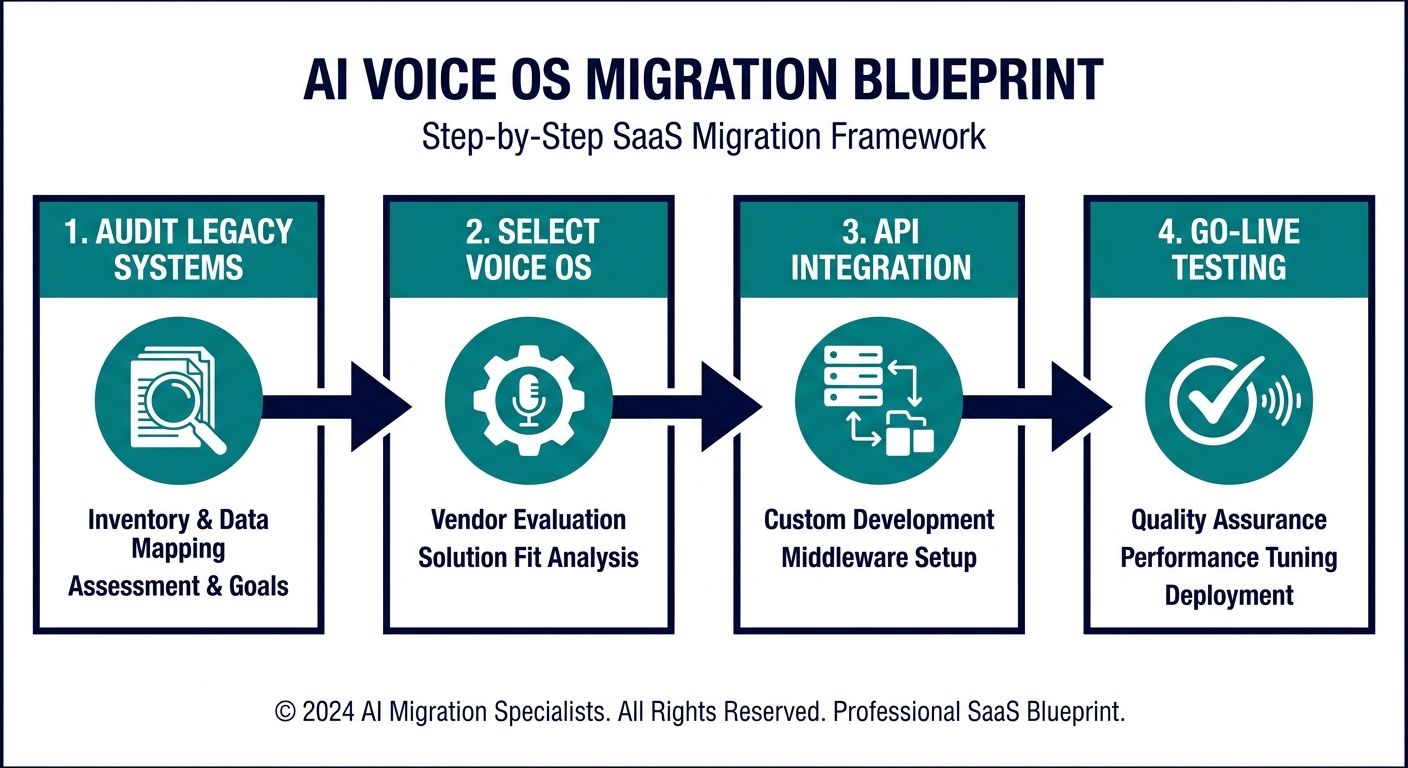
Migrating to an AI Voice OS is a multifaceted architectural transformation. It requires transitioning from rigid, decision-tree-based logic to dynamic, context-aware generative systems. The blueprint for this migration is divided into distinct, highly technical phases to ensure operational continuity and optimal performance.
1. Infrastructure Audit and Telephony Integration
Before deploying any AI models, a thorough audit of existing telephony infrastructure is mandatory. Enterprises must evaluate their current Session Initiation Protocol (SIP) trunking, Private Branch Exchange (PBX) systems, and WebRTC capabilities. The migration blueprint dictates a phased cutover strategy, often utilizing a robust API-first approach to intercept and route calls. Evaluators must ensure that the chosen Voice OS supports ultra-low latency streaming protocols, as traditional HTTP REST requests introduce unacceptable delays in conversational voice interactions. Bi-directional audio streaming via WebSockets or gRPC is critical for maintaining a natural conversational cadence.
2. Moving from Prompt Engineering to Context Engineering
The most critical paradigm shift in the AI Voice OS migration blueprint is abandoning monolithic prompt engineering in favor of advanced Context Engineering. Traditional applications often attempt to inject vast, unstructured documents into the Large Language Model's (LLM) context window. In a voice environment, this leads to immense token consumption, severe latency spikes, and a high probability of hallucination.
Alchemyst's Kathan engine solves this through a computational process known as Context Arithmetic for Voice. Instead of overloading the prompt, the system utilizes a set-algebraic pipeline to dynamically retrieve, filter, and inject only the precise informational nodes required for a given user query. This highly optimized approach ensures that the voice agent possesses deep, deterministic knowledge without the computational bloat.
3. The Five-Stage Context Determination Pipeline
At the core of a successful technical integration is the data pipeline. The Kathan engine employs a rigorous five-stage pipeline for context determination, which must be carefully mapped during your migration:
- Semantic Similarity Search: The system converts enterprise knowledge bases (policies, user data, product catalogs) into high-dimensional vector embeddings. When a user speaks, the transcribed query is vectorized, and the engine performs a cosine similarity search to retrieve the most semantically relevant nodes.
- Metadata Filtering: Pure semantic search is prone to contextual errors (e.g., retrieving a policy for the wrong state). Metadata filtering applies deterministic, set-theoretic rules to filter out results that do not match the specific user's geographic, account, or temporal parameters.
- Deduplication: Disparate data sources often contain overlapping information. The deduplication stage uses computational logic to identify and merge redundant data points, ensuring the LLM is not processing the same information multiple times, which wastes tokens and slows down response times.
- Ranking: The remaining informational nodes are scored and ranked based on relevance, recency, and contextual weight. The highest-scoring nodes are prioritized for injection into the prompt.
- Set-Algebraic Orchestration: The final stage treats the filtered data sets mathematically, using unions and intersections to build a perfectly tailored, minimal context payload. This precise payload guarantees that the voice agent answers accurately and efficiently.
4. Data Migration, Security, and Compliance
Data migration is not merely about moving files; it involves structuring data for optimal retrieval by the Voice OS. Enterprise migration requires rigorous data sanitization. Furthermore, processing voice data introduces severe security and compliance hurdles. The migration blueprint must include real-time Personally Identifiable Information (PII) redaction algorithms before audio streams are sent to external Speech-to-Text (STT) or LLM providers. Ensuring SOC2 and HIPAA compliance means establishing secure, encrypted tunnels and utilizing localized or highly secure isolated instances for vector databases and context processing.
Phase 2: Advanced ROI Calculation for Businesses
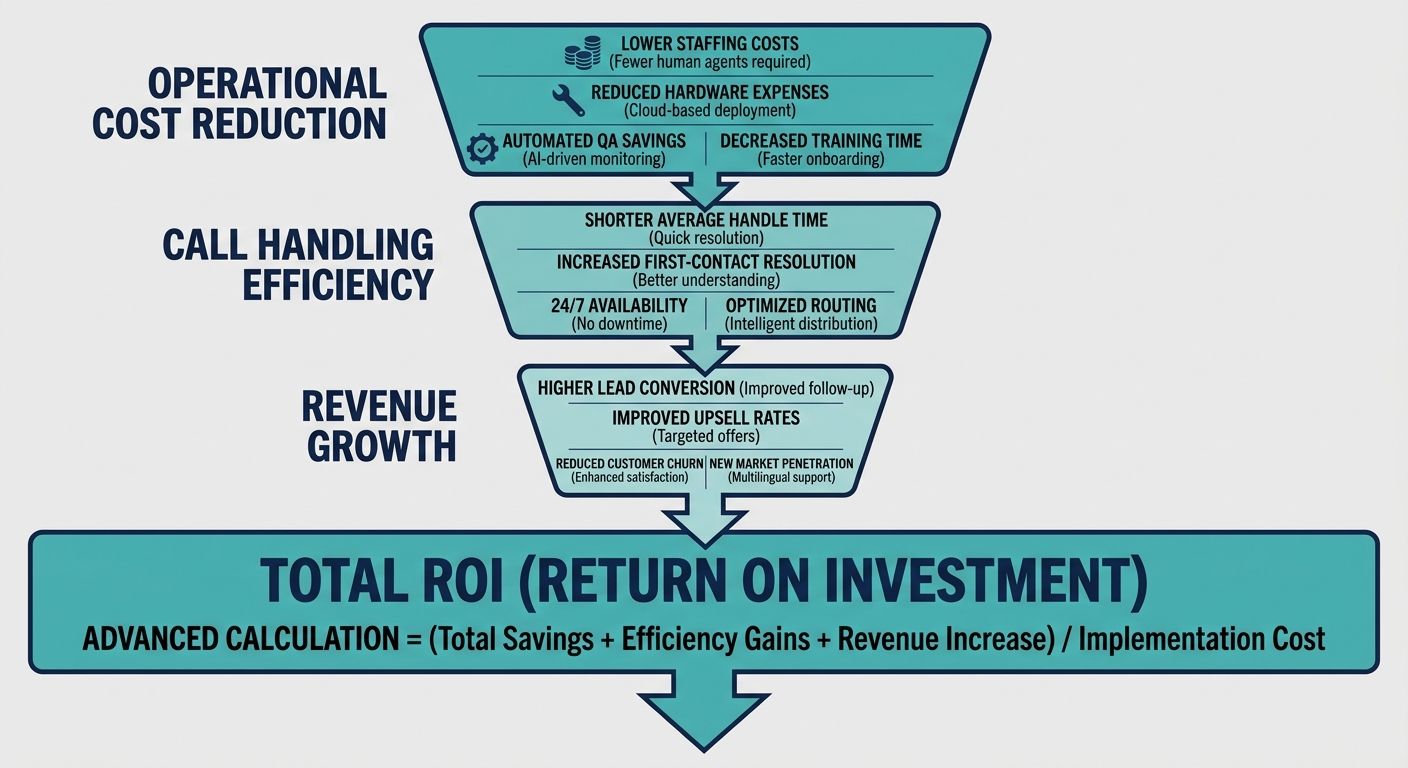
Top-ranking generic guides often summarize ROI as simply "reducing human headcount." This superficial analysis fails to account for the complex unit economics of AI voice systems. A highly structured AI Voice OS migration blueprint and ROI calculation must incorporate specific cost analyses, API token economics, latency impacts, and infrastructure overhead.
Deconstructing the Unit Economics of Voice AI
To calculate true ROI, businesses must analyze the Cost Per Call (CPC) or Cost Per Minute (CPM) of the AI Voice OS versus traditional human agents. However, the AI cost is variable and comprises several distinct API layers:
- Speech-to-Text (STT) Costs: Billed per second of incoming audio.
- LLM Inference Costs: Billed per input token (context) and output token (generated response).
- Text-to-Speech (TTS) Costs: Billed per character or per second of generated audio.
- Platform/Orchestration Costs: The infrastructure running the WebSockets, state management, and the Kathan engine.
The ROI Formula
A structured ROI framework utilizes the following baseline formula:
Net ROI = (Value of Automated Resolutions + Value of Deflected Escalations + Increased CSAT Revenue) - (Implementation Costs + Total Voice OS Infrastructure Costs + Maintenance Overhead)
While human agents may cost $1.00 to $2.00 per minute burdened, an unoptimized Voice AI might cost $0.20 to $0.40 per minute. While this appears to be a massive saving, unoptimized systems with high latency lead to user abandonment, dropped calls, and frustrated customers who eventually require escalated, higher-cost human intervention—effectively destroying the anticipated ROI.
How Context Arithmetic Drives Tangible ROI
This is where Alchemyst's Kathan engine provides a clear competitive advantage in ROI analysis. The relationship between context handling and financial return is direct and measurable:
1. Token Cost Reduction: By utilizing the five-stage set-algebraic pipeline, the Kathan engine drastically reduces the size of the prompt payload. Instead of sending 5,000 tokens of semi-relevant documentation to the LLM for every conversational turn, the engine sends 500 tokens of highly targeted, deduplicated context. Over millions of interactions, this 90% reduction in input tokens translates to massive, compounding cost savings.
2. Latency Reduction and Revenue Retention: Processing smaller context payloads accelerates LLM inference times. In voice interactions, delays longer than 700 milliseconds create awkward pauses and degrade the user experience. By minimizing latency through optimized information retrieval, businesses maintain natural conversation flows, decreasing call abandonment rates and increasing successful task completion. Higher task completion directly correlates to revenue protection.
3. Hallucination Mitigation: Generic voice agents hallucinate when forced to reason over vast, conflicting datasets. When an AI agent confidently provides incorrect information (e.g., authorizing an invalid refund or providing wrong medical prep instructions), the financial and reputational cost is catastrophic. The metadata filtering and ranking mechanisms of the Kathan engine ensure absolute deterministic accuracy, practically eliminating liability-inducing hallucinations.
Phase 3: Concrete Industry-Focused Use Cases
Applying the AI Voice OS migration blueprint and ROI calculation to specific verticals reveals exactly how deep technical integration yields specialized business value.
Healthcare: Triage and Patient Scheduling
In healthcare, voice agents manage appointment scheduling, prescription refills, and preliminary triage. Migration Blueprint: Requires deep integration with Electronic Health Records (EHR) via HL7/FHIR APIs and stringent HIPAA-compliant PII redaction. ROI Calculation: Value is driven by reducing the administrative burden on nursing staff and minimizing appointment no-shows through automated, intelligent outbound reminders. The context arithmetic ensures the agent cross-references physician availability, patient history, and facility capabilities instantly, without exposing generalized patient data.
Financial Services: Secure Account Management
Banks and credit unions utilize Voice OS for balance inquiries, fraud alerts, and loan application statuses. Migration Blueprint: Involves integrating voice biometric authentication to replace standard security questions, alongside secure, tokenized API connections to core banking systems. ROI Calculation: The primary ROI driver is deflecting high-volume, low-complexity support tickets away from expensive tier-1 human agents. Additionally, contextually accurate AI reduces the risk of social engineering attacks, safeguarding institutional assets.
E-Commerce and Retail: Complex Order Troubleshooting
Retailers deploy AI voice agents to handle "Where is my order?" (WISMO) queries, returns processing, and warranty claims. Migration Blueprint: Requires real-time hooks into inventory management and logistics APIs. ROI Calculation: By utilizing deduplication and semantic search, the agent can instantly parse vast product catalogs and shipping policies. The ROI is measured not just in reduced support costs, but in increased Customer Satisfaction (CSAT) scores, which directly lead to higher customer lifetime value (LTV) and repeat purchase rates.
Phase 4: Developer Ecosystem and Post-Migration Optimization
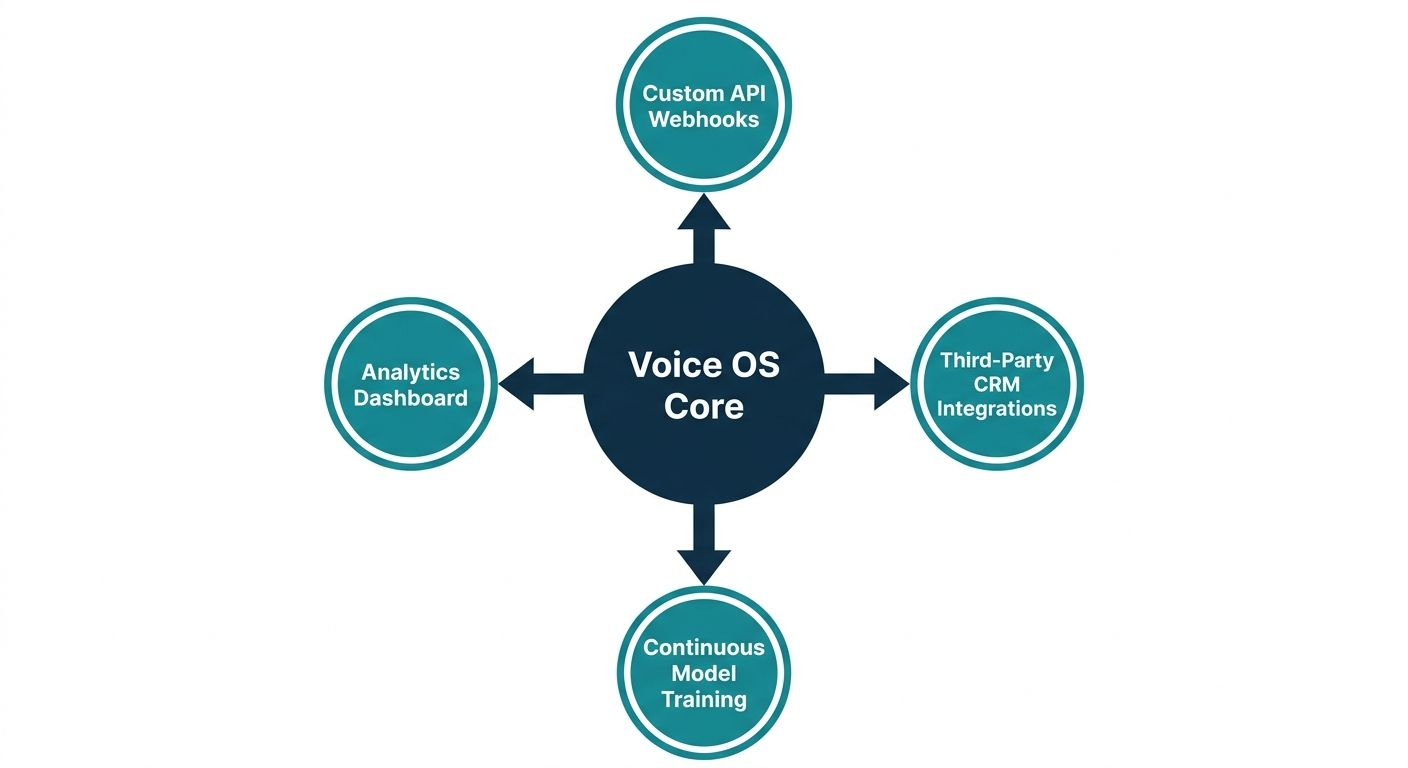
A successful enterprise AI voice strategy does not end on deployment day. Post-migration optimization is a continuous cycle of refining vector databases, adjusting metadata filters, and monitoring unit economics. To support this ongoing operational phase, empowering technical teams is paramount.
Alchemyst champions a robust developer community, providing extensive resources via Community and Events channels. Furthermore, providing technical teams with direct self-service platform access through an Open Dashboard is critical. This allows developers to monitor the Kathan engine's context pipeline in real-time, trace latency bottlenecks, evaluate semantic search accuracy, and independently manage and fine-tune their custom enterprise agents without relying on cumbersome vendor support cycles.
Conclusion
Executing an AI Voice OS migration is a complex, high-stakes technical endeavor that demands far more than basic API stitching. By following this definitive AI Voice OS migration blueprint and ROI calculation framework, organizations can confidently transition their telephony infrastructure into the modern era. Leveraging advanced architectural concepts like the Kathan engine's context arithmetic and set-algebraic pipelines ensures that the resulting voice agents are not only highly intelligent and secure but also financially viable, delivering a verifiable, mathematically proven return on investment.