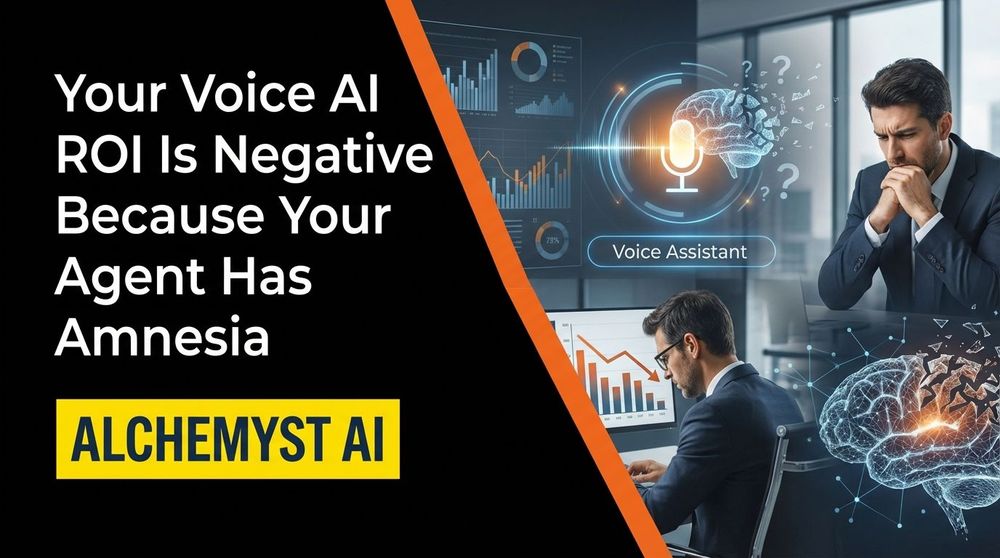
A typical voice AI deployment bills per minute of connected conversation. If the voice agent can't qualify a lead in the first 60 seconds because it starts every call from zero, the average call length inflates. Longer calls on unqualified leads means higher cost per acquisition. The ROI goes negative not because the Kathan voice OS is expensive, but because the agent wastes time re-establishing what it should already know.
The Unit Economics of Amnesia
Let's walk through the math using real data from our deployments — with over 500,000+ calls deployed daily for use cases ranging from enrollment outreach to customer feedback, across 12+ Indian languages (including Hindi, Tamil, Telugu, Gujarati, Kannada, Marathi, Bengali, Malayalam, Punjabi, Odia, Assamese, and Urdu) and international languages like English, Arabic, Spanish, French, Mandarin, and Japanese.
| Metric | Value |
|---|---|
| Total dials per day | 500,000+ |
| Connected calls (estimated) | 193,500 |
| Meaningful conversations (>1 min) | 41,215 |
| Total conversation minutes | 82,430 |
| Cost per minute | ₹9 |
| Total spend (daily) | ₹741,870 |
| Cost per meaningful interaction | ₹18 |
₹18
Cost per meaningful interaction (Lead Qualification)
Now, let's look at a different use case: NPS feedback collection. Here, the goal isn't a long conversation but an efficient, structured data capture. The economics look different, but the principle is the same: context drives down cost per outcome.
| Metric | Value |
|---|---|
| Total learners called | 15,088 |
| Total calls made | 14,258 |
| Connection rate | 35.2% |
| Total spend | ₹11,963 |
| Cost per minute | ₹3 |
| Cost per NPS response | ₹10.79 |
₹10.79
Cost per NPS Response (Feedback Collection)
The per-minute rate is 3x lower (₹3 vs. ₹9), but more importantly, the cost per outcome is tailored to the job. For lead qualification, it was cost per qualified lead; for feedback, it was cost per NPS response. In both scenarios, a stateless voice agent would have inflated costs by wasting time, driving the ROI negative.
Where the Money Leaks: The "Context Tax"
When a Kathan-powered agent (or कथन, as we call it internally) has no context, every call incurs what we call the context tax — the overhead of re-establishing information that should have carried forward from prior interactions. This manifests in three ways:
- Re-identification overhead — The voice agent spends 15–30 seconds confirming who the person is, what they're interested in, and why they're being called. On a retarget call, this should be zero.
- Script redundancy — The Kathan engine runs through the full pitch because it doesn't know which parts the lead has already heard. A context-aware agent skips covered ground and goes straight to the next step.
- Missed qualification signals — Without prior interaction data, the Kathan OS can't distinguish a warm lead from a cold one. It spends equal time on both, diluting the ROI of every connected minute.
Across over 500,000 daily calls, even 20 seconds of wasted overhead per call adds up to over 2,700 hours of billable time that produces no value. At ₹9/minute, that's over ₹14,58,000 in pure waste. Context engineering eliminates this overhead by ensuring the agent knows who it's calling, what they discussed before, and what the optimal next step is — before the call connects.
Context as Cost Reduction
The concept is straightforward: context reduces cost per outcome. When the agent knows who it's calling, it skips the identification phase. When it knows the prior objection, it addresses it directly instead of running through the full script. This shaves 20–40 seconds per call.
In our deployments, context-aware retarget campaigns don't just connect more often (57.3% vs. 38.7% on first attempts) — they also converted more efficiently. The meaningful conversation rate on retargets was 21.3% compared to 14.4% on cold campaigns. More connections, higher quality conversations, lower cost per outcome. This is the power of an enterprise voice OS built in India, for the world.
"Voice AI ROI goes negative not because the technology is expensive, but because stateless agents waste time on every call re-establishing what they should already know. Context engineering with a voice OS like Kathan turns that overhead into margin."
How to Calculate Your Own Voice AI ROI
Most vendors report cost per minute or cost per call. Neither metric captures what matters. Here's the framework that does:
| Metric | Formula | What It Reveals |
|---|---|---|
| Cost per connected minute | Total spend ÷ Connected minutes | Your base rate — but doesn't account for quality |
| Cost per meaningful interaction | Total spend ÷ Conversations >1 min | The real efficiency metric — how much you pay for conversations that matter |
| Context overhead ratio | Avg. first 30s of call ÷ Total call length | How much of each call is wasted on re-identification and script setup |
| Retarget lift | Retarget connection rate ÷ Cold connection rate | If this ratio is close to 1.0, your agent has no context memory |
If your retarget lift is below 1.2x, your agent is treating retarget campaigns the same as cold outreach. The context isn't carrying forward. Your ROI will stay negative until that changes.
Alchemyst's Kathan enterprise voice OS delivered ₹18 per meaningful interaction across millions of calls — not because the per-minute rate was low, but because context engineering eliminated the waste that makes every other deployment expensive.