The Evolution of the AI Context Layer for Voice
The landscape of enterprise artificial intelligence is undergoing a profound transformation. We are moving rapidly from asynchronous, text-based chatbots to synchronous, real-time voice agents capable of conducting complex business workflows. However, many enterprise architects quickly encounter a significant hurdle: lifting a traditional text-based context management system and dropping it into a voice environment results in disjointed, laggy, and unnatural user experiences. Understanding the highly specialized voice-specific architectural requirements for AI context layer design is no longer optional. It is a critical necessity for any organization looking to deploy scalable, human-like conversational AI systems.
Current industry resources broadly cover general AI agent architectures and basic context layers but consistently lack deep, prescriptive technical details tailored to the unique challenges of voice AI. Many solutions focus on drop-in memory infrastructure for text applications, missing the fundamental differences in how spoken language operates. Voice input is continuous, dynamic, often noisy, and laden with non-verbal cues. If an AI context layer is not architected specifically for these nuances, it will fail to maintain conversational coherence. This guide provides a deep technical dive into the specific architectural patterns required to power real-time, context-aware voice agents.
The Fundamental Shift: Text vs. Spoken Language Context
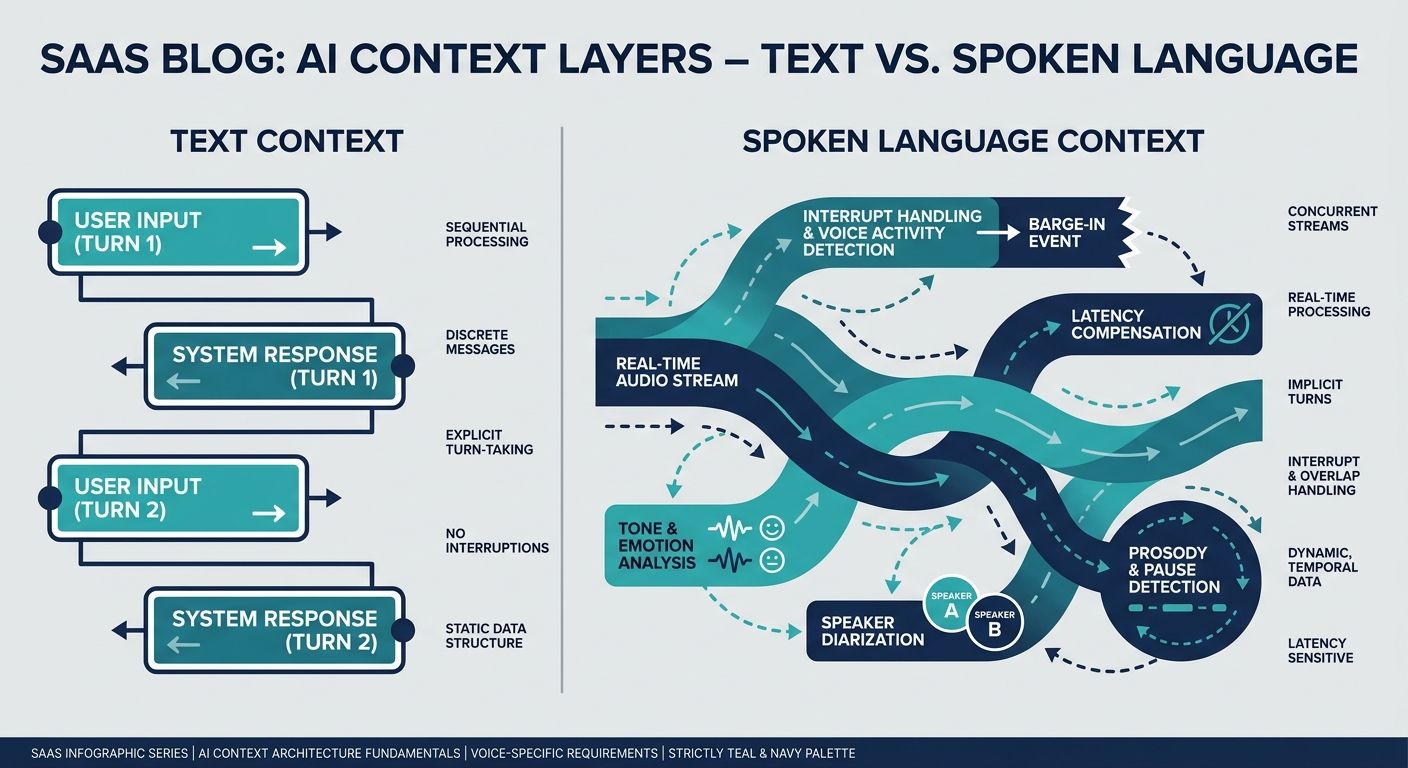
To grasp the voice-specific architectural requirements for AI context layer design, we must first dissect why spoken language breaks traditional state management systems. In text-based interactions, input is discrete, cleanly transcribed exactly as typed, and delivered in completed semantic chunks. The context layer simply appends this neat chunk to a conversation history array and passes it to a Large Language Model (LLM).
Voice input is entirely different. It arrives as a continuous audio stream fraught with hesitations, self-corrections, background noise, and varying acoustic environments. A user might say, 'I need to book a flight to, um, no wait, make it a train to Boston.' A text-focused context layer might struggle with this unstructured flow, but a voice-specific context layer must instantly normalize this dynamic input, extract the final intent, and discard the conversational filler without losing the temporal context. Furthermore, human speech involves complex turn-taking dynamics, prosody changes, and simultaneous overlapping speech, all of which must be tracked and managed by the context architecture.
Core Voice-Specific Architectural Requirements for AI Context Layers
1. Ultra-Low Latency Processing and Real-Time State Management
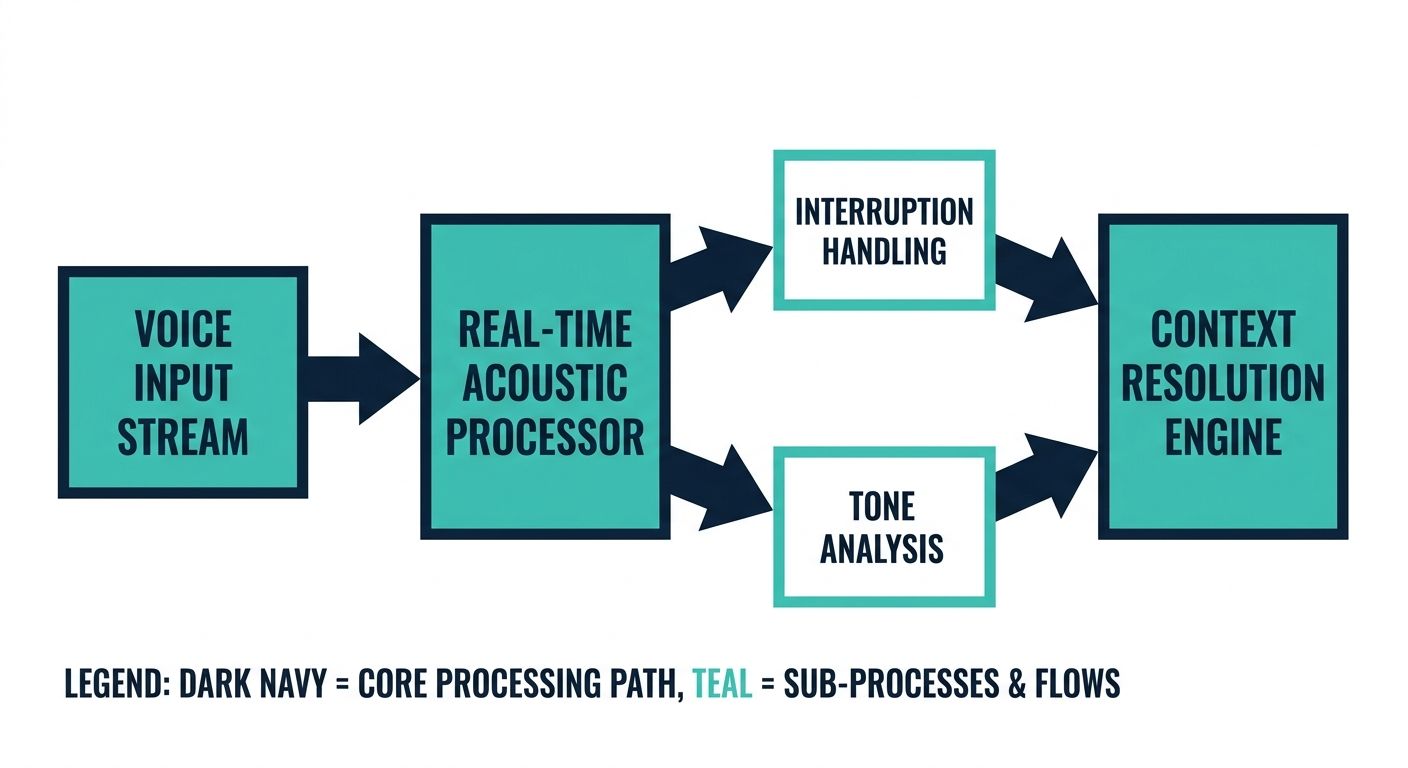
The most unforgiving constraint in voice AI is latency. Human beings perceive delays in conversational turn-taking that exceed 500 milliseconds as sluggish and unnatural. In a standard voice pipeline, the audio must pass through Voice Activity Detection (VAD), Speech-to-Text (STT), the AI context layer, the LLM, and finally Text-to-Speech (TTS). Because STT, LLM generation, and TTS synthesis consume the vast majority of this strict latency budget, the context layer must operate in near-zero time.
This necessitates an ultra-low latency, in-memory processing architecture for short-term context. Disk-based retrieval is inherently too slow for mid-conversation state updates. The architecture must separate short-term acoustic/conversational context from long-term persistent semantic memory. Short-term context data such as current conversational turn status, immediate user intent, and active session variables must be stored in highly optimized, memory-mapped databases. Long-term contextual data, such as historical user preferences, can be retrieved asynchronously while the initial conversational pleasantries are being synthesized, ensuring the system never blocks the critical real-time audio loop.
2. Seamless Integration with STT Pipelines for Dynamic Normalization
A fatal flaw in many generalized AI architectures is treating STT as an isolated black box that merely hands text to the context layer. In a specialized voice architecture, the context layer and the STT engine must be deeply integrated. This is typically achieved through context-aware STT biasing and dynamic vocabulary weighting.
Because voice inputs are frequently noisy, the STT engine may generate multiple transcription hypotheses with varying confidence scores. A voice-specific context layer must accept these probabilistic hypotheses rather than a single deterministic text string. For instance, if the background is noisy and the STT outputs 'I want to by a sheer' (low confidence) versus 'I want to buy a share' (medium confidence), the context layer checks the active conversational state. If the user is operating within a financial services agent context, the architecture dynamically weights the financial terminology, instantly correcting the STT output before it reaches the LLM. This dynamic input normalization is a mandatory architectural requirement for maintaining accuracy in real-world acoustic environments.
3. Advanced Text-to-Speech (TTS) Orchestration and Prosody Control
Just as the context layer must influence the STT, it must directly orchestrate the TTS output. Text-based architectures only need to generate a text string. Voice architectures must generate speech that carries the correct emotional tone, pacing, and inflection. This requires the context layer to maintain an ongoing emotional and semantic state tracker for the conversation.
When the LLM generates a response, the context layer must inject appropriate Speech Synthesis Markup Language (SSML) tags before routing the payload to the TTS engine. If the context layer detects that a user is frustrated based on repeated conversational turns and elevated acoustic volume from the STT metadata, it must append tags that instruct the TTS to speak at a slower, calmer, and more empathetic pitch. This level of prosody management ensures that the AI agent does not sound disjointed or socially unaware, which is a common failure point in legacy IVR systems.
Architectural Patterns for Managing Short-Term Acoustic Context
Mastering Turn-Taking and Barge-In Scenarios
One of the most complex voice-specific architectural requirements for AI context layer systems is handling interruptions, commonly known as barge-in. In a natural conversation, humans frequently talk over one another. If an AI agent is reading a long list of options and the user interrupts by saying 'The third one', the architecture must handle this event flawlessly.
Traditional text systems completely fail here because they assume the bot finishes its turn before the user speaks. A robust voice context architecture implements a synchronized rollback mechanism. When the VAD detects a user interruption, the TTS stream is instantly halted. The context layer must then calculate exactly which words the TTS had successfully synthesized and played to the user up to that exact millisecond. It must strip the unplayed words from the agent's short-term memory state. If this rollback does not occur, the LLM will 'remember' saying things the user never actually heard, leading to catastrophic context hallucination and complete conversational breakdown.
Incorporating Acoustic Features as Contextual Data
Beyond semantic meaning, how a user speaks provides critical context. A sophisticated AI context layer designed for voice must ingest acoustic metadata alongside the transcribed text. This includes metrics like speech rate, pitch variations, and pause durations.
For example, a two-second pause in text is invisible. In voice, a two-second pause might indicate hesitation, confusion, or that the user is simply thinking. The context layer uses this acoustic data to dynamically adjust the VAD threshold. If the system detects a complex multi-part intent forming, the context layer instructs the VAD to wait longer before assuming the user has finished their turn. This prevents the frustrating experience of the AI cutting the user off mid-sentence.
Addressing Enterprise Gaps with Advanced Context Engines
Many generalized platforms position themselves as memory layers for AI agents, offering standard drop-in memory infrastructure. However, enterprise voice agents require a more nuanced approach. Platforms like Alchemyst AI utilize advanced AI-native context management frameworks, such as the Kathan engine, to solve these specific enterprise requirements. The Kathan engine exemplifies how to structure persistent information storage specifically for dynamic AI interactions.
In enterprise deployments spanning healthcare, e-commerce, and finance, the context layer must bridge real-time voice processing with complex backend workflows. This requires custom connectors that can pull secure, industry-specific data into the active voice context window within milliseconds. Furthermore, these architectures require advanced memory compression engines. Instead of retaining every 'um' and 'ah' from a thirty-minute phone call, the context layer continuously summarizes the acoustic interaction into highly compressed semantic state vectors. This ensures long-term memory persists across multiple user sessions without bloating the active context window and destroying latency budgets.
Practical Implementation Strategies for Voice AI Networks
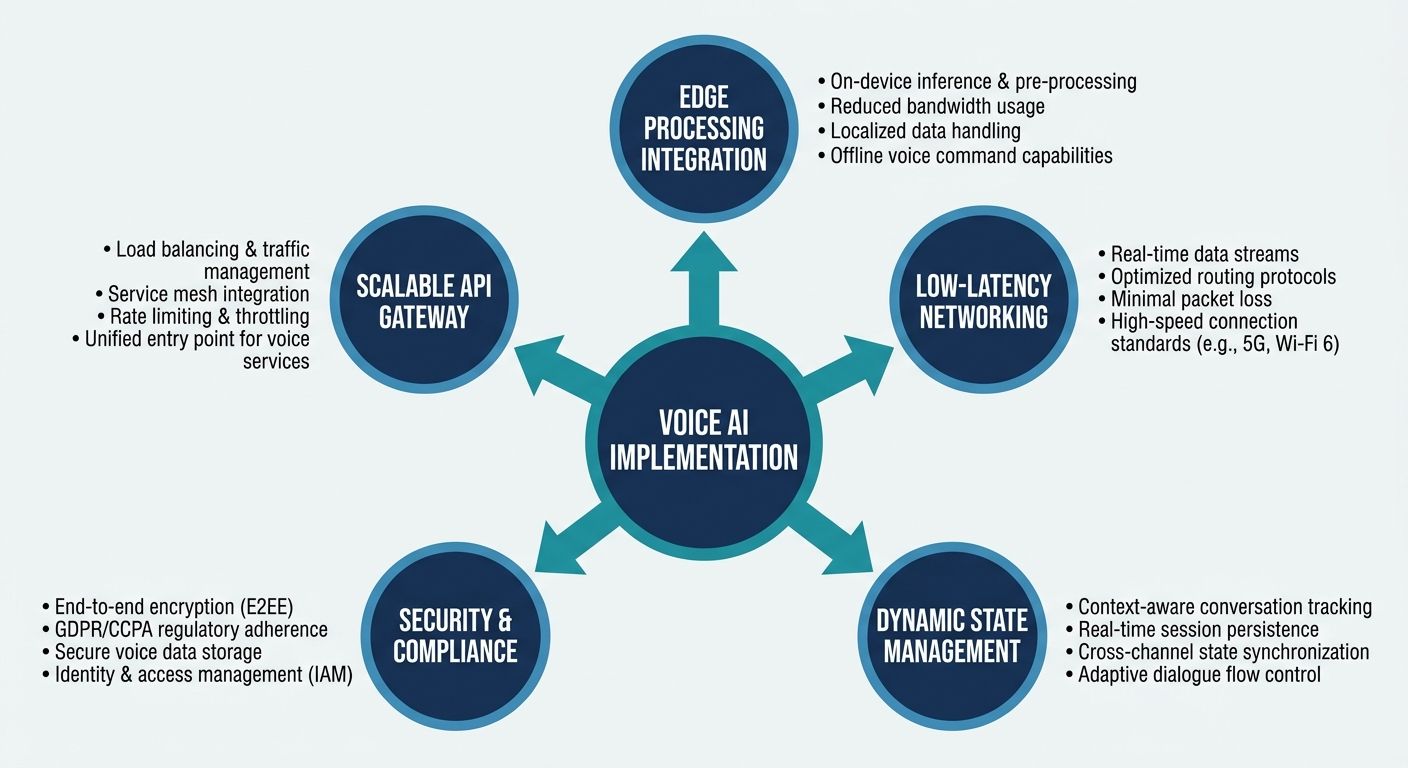
Implementing these voice-specific architectural requirements for AI context layer infrastructure demands a strategic approach. Engineering teams must pivot from synchronous, blocking API calls to asynchronous, event-driven architectures. Here are critical implementation strategies:
- Implement Streaming Pipelines: The context layer must support chunk-based processing. Do not wait for a full sentence to be transcribed. The context layer should begin analyzing partial STT hypotheses as they stream in, pre-fetching relevant database records to save precious milliseconds.
- Deploy Dual-State Memory Systems: Maintain a strict separation between ephemeral conversational state (managed in Redis or similar high-speed in-memory stores) and persistent user knowledge (managed in vector databases).
- Build Graceful Degradation Pathways: When voice inputs are too noisy and confidence scores plummet, the context layer must orchestrate targeted clarification prompts rather than allowing the LLM to guess the intent randomly.
- Adopt AI-Native Context Platforms: Leveraging established context management platforms like Alchemyst AI allows enterprises to focus on agent persona and business logic rather than building complex, low-level memory compression and state rollback algorithms from scratch.
Key Performance Indicators for Voice Context Architecture
To ensure your voice-specific context layer is performing optimally, you must track metrics that go beyond traditional web application monitoring. Standard response times are insufficient; you must measure the holistic conversational flow.
- Context Retrieval Latency (CRL): The time it takes for the context layer to enrich an incoming STT payload with historical user data and active state variables. This must consistently remain under 50 milliseconds.
- Interruption Handling Success Rate (IHSR): The percentage of barge-in events where the context layer successfully rolled back the agent memory state and correctly processed the user interruption without hallucinating previously unspoken text.
- Context-Aware Word Error Rate (WER): The accuracy of the STT system when actively biased by the context layer, compared to the baseline STT accuracy without contextual weighting. This demonstrates the ROI of integrating your context layer directly with the transcription pipeline.
Conclusion: Future-Proofing Your Enterprise Voice Agent
The transition to voice-first AI interfaces represents a monumental shift in how humans interact with machines. General-purpose text architectures are fundamentally unequipped to handle the latency demands, acoustic nuances, and dynamic turn-taking inherent in spoken conversation. By adhering to the precise voice-specific architectural requirements for AI context layer design outlined in this guide, enterprises can overcome the limitations of generic AI agents.
Focusing on ultra-low latency memory management, deep integration with STT and TTS pipelines, robust barge-in handling, and advanced memory compression engines will allow you to build conversational experiences that feel genuinely human. Platforms offering specialized AI-native context management are paving the way for this future, enabling businesses to deploy scalable, secure, and incredibly responsive voice AI solutions that drive real operational efficiency and user satisfaction.