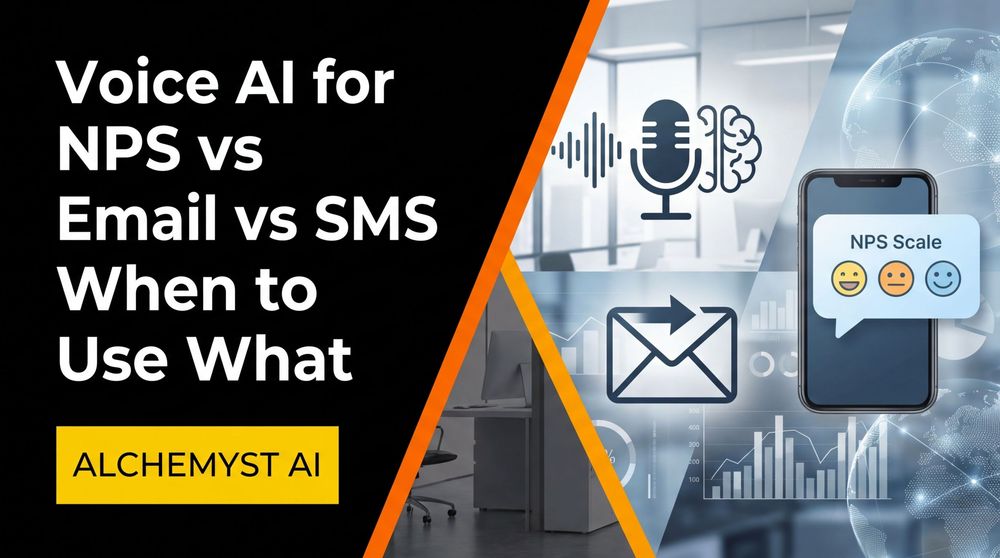
If you're evaluating how to collect NPS at scale, you've likely considered email, SMS, and now, conversational voice agents. Each channel has a defensible use case. The mistake most CX teams make is choosing one channel for everything — or choosing based on cost per send rather than value per response. This is a neutral comparison to help you decide when each channel makes sense for your goals.
The Three Channels, Compared
| Dimension | Email NPS | SMS NPS | Kathan NPS |
|---|---|---|---|
| Response rate | 12–15% | 20–25% | 35.2% (Unacademy benchmark) |
| Cost per response | ₹2–5 | ₹5–10 | ₹10.79 |
| Qualitative depth | Numeric + optional comment (80% skip) | Numeric + 1–2 words | Full conversational feedback with probing |
| Collection speed | 2–3 week window | 3–5 days | 1–3 days |
| Personalization | Name merge fields | Name + basic context | Full CRM + interaction history |
| Follow-up capability | None (one-shot) | Limited (character constraints) | Real-time conversational probing |
| Data structure | Score + free text | Score + terse text | Score + structured qualitative insights |
| Best for | Large-scale trendlines | Mobile-first, time-sensitive | High-value cohorts, product decisions |
Email NPS: The Trendline Tool
Email NPS is best for large-scale, low-cost, numeric-only collection. If you need to survey 100,000+ users annually and track a trendline quarter over quarter, email is the right channel. The response rate is low (12–15%), but at ₹2–5 per response, the math works for volume plays.
The limitation is qualitative depth. Email surveys include a comment box that 80% of respondents skip. The 20% who do write something typically leave one sentence — "Good service" or "Too expensive" — that's too vague to drive product decisions. You get a score you can track but can't explain.
Best for: Annual or quarterly surveys across your full user base. Benchmarking against industry averages. Board-level reporting where the trendline matters more than the individual data point.
SMS NPS: The Quick Pulse
SMS NPS works for mobile-first audiences and time-sensitive collection. Post-purchase, post-class, post-support — moments where you want a quick pulse within hours, not days. Response rates are higher than email (20–25%) because SMS has higher open rates and the interaction is frictionless.
The limitation is depth. Character limits and typing friction reduce qualitative responses to one or two words. "Good," "Okay," "Slow delivery." You get slightly more signal than email, but not enough to understand the why behind the score. SMS NPS is a thermometer, not a diagnostic.
Best for: Post-transaction feedback. Mobile-first audiences (delivery apps, ride-sharing, quick commerce). Situations where speed matters more than depth.
Kathan NPS: The Insight Engine
Alchemyst's Kathan (कथन) voice OS is best for high-value cohorts where qualitative feedback drives product decisions. When Unacademy deployed Kathan across 15,088 learners, the voice agent didn't just ask "How would you rate us on a scale of 0–10?" It held a natural, human-like conversation. This approach is built in India, for the world, and is now handling over 500,000+ calls deployed daily.
A learner who scored a 6 was asked: "Is that related to the video quality issues in your Advanced Tax module?" — because the Kathan engine knew, from its context, that this learner was enrolled in that specific course and had flagged buffering issues in a support ticket. The follow-up question was impossible without context. The insight it produced was impossible without the follow-up.
₹10.79
Cost per NPS response with full qualitative feedback — Unacademy deployment
The limitation is cost. At ₹10.79 per response, a Kathan-powered survey is 2–5x more expensive than email or SMS per response. It's not the right channel for surveying your entire user base. It's the right channel for the segments where the qualitative depth justifies the investment.
Best for: Paid subscribers and premium cohorts. Enterprise accounts where churn has high revenue impact. At-risk segments with low email engagement. Product decisions that hinge on understanding the "why" behind the score.
The Decision Framework
Should You Use Kathan for NPS?
- Do you need qualitative feedback, not just a score? → If no, use Email.
- Is this a high-value cohort where churn has significant revenue impact? → If no, use SMS.
- Does the product team need to understand the 'why' behind scores to make decisions? → If yes, use the Kathan voice OS.
- Is the segment's email engagement low (< 10% open rate)? → If yes, a voice agent cuts through inbox noise.
- Are you making a time-sensitive decision (launch feedback, at-risk intervention)? → If yes, Kathan's 1–3 day cycle beats email's 3-week window.
When to Combine Channels
The strongest NPS programs don't choose one channel. They layer them:
| Layer | Channel | Audience | Purpose |
|---|---|---|---|
| Base layer | Full user base (100K+) | Quarterly trendline, benchmark tracking | |
| Pulse layer | SMS | Post-transaction, mobile-first | Real-time satisfaction signals |
| Insight layer | Kathan | High-value cohorts (top 10–20%) | Qualitative depth, product intelligence |
Run email NPS across your full base for the trendline. Use SMS for transactional moments. Deploy Alchemyst's Kathan engine for the segments where understanding the reason behind the score changes what you build next. The voice data enriches and explains the patterns in the email and SMS data.
Cross-Validation: Two Deployments, Consistent Results
The Kathan enterprise voice OS has been deployed across two EdTech companies with different use cases. Unacademy used it for NPS collection (35.2% connection rate, ₹10.79/response). JK Shah Classes used it for enrollment outreach (38.7% connection rate, ₹24.93/qualified interaction). Different objectives, different price points (₹3/min vs. ₹9/min), consistent results. The common factor is the context layer, not the channel. The platform supports over 12+ Indian languages (Hindi, Tamil, Telugu, Gujarati, Kannada, Marathi, Bengali, Malayalam, Punjabi, Odia, Assamese, Urdu) and international languages like English, Arabic, Spanish, French, Mandarin, and Japanese.
"A learner who scores a 6 and explains why is worth more than a learner who scores a 6 in an SMS survey. The voice agent's value isn't in the NPS number itself — you could get that from email. It's in the follow-up conversation that captures the reason. Context makes that follow-up conversation productive."
What to Ask Your Current NPS Vendor
Five Questions for Your NPS Tool Evaluation
- What is your response rate benchmark for my industry? (If they cite email-only benchmarks, they're not considering voice.)
- Can the agent reference my customer's specific product usage during the NPS conversation? (Context-awareness, not just personalization.)
- How quickly do I get structured, queryable data after collection starts? (Days, not weeks.)
- What does a single response look like? Show me a real example. (Score + qualitative insight, not just a number.)
- What's the cost per actionable insight, not just cost per send? (The metric that matters.)
If you're evaluating NPS collection methods and your current approach returns numbers without reasons, the gap isn't in your survey design. It's in your channel choice. See how Alchemyst's Kathan voice OS works — and decide whether the qualitative depth justifies the investment for your high-value segments.